Market Ticker

Translate

Saturday, November 19, 2011

Does Sushil Kumar (KBC winner) require a Financial Plan ?

We all know that Sushil kumar has won 5 crores from KBC few days back (actually 3.5 crores after tax) and now he is already being approached by wealth managers, relationships managers to advise him on how to “invest his money”. So I want to just discuss my thoughts with you all on how Sushil kumar should put his money at work ? Does he really need a Financial Plan ? Does he really need an advisor ?

Sushil Kumar 5 crore KBC winner
Let us see what he can do with his money and how I think he should utilize his 3.5 crores. Given his background and education level and assuming that he listens to me, here is what I would suggest Sushil Kumar. Divide your money in 4 buckets A (1 crore) , B (1 crore) , C (1 crore) and D (50 lacs)

Bucket A (Security of future)

The first thing which I would tell Sushil Kumar is that he should just keep things simple and simply keep that 1 crore in a Fixed Deposit and let it accumulate there without any complication. This part of his wealth should be there incase THINGS GO HORRIBLY WRONG ever , he can just leave this part as it is for growth, even if its going to increase at a slower pace compared to equity or anything else.

Bucket B (Regular Income and Security of Capital)

I would suggest him to use the next bucket to generate a regular income along with his capital being secure, again there can be many ways of doing this , but considering his background and assuming that he might not be too sure about financial matters , again I would recommend him to put his next 1 crore into a fixed deposit with a monthly or a quarterly payout of interest . This will make sure that his initial capital of 1 crore is secure and he will start getting an income of Rs 65,000 – 70,000 per month (before tax) .

This income of 65,000 – 70,000 will be more than enough for him to live his regular life, thanks to him not very much addicted to junk foods , extravagance and other useless spendings which our generations have. He will surely be left with a lot of money each month or quarter and thats where he can put some money in equity on regular basis . No stocks , no mutual funds , just plain index funds, so that he does not have to bother about funds not performing every year and does not require a short-term review.

Bucket C (Assets creation , Education , Business)

Once his worst case is covered (bucket A) , his regular income is taken care , now he can use the next 1 crore for building a new house for himself and his family , he can also use some part of his money to fund his education and some part he can use to start a new business which can again open a new stream of income for him) . This purpose of this 1 crore is to take care of all the things which he wanted to do in his life. This part is not to save , but to utilize for his aspirations and his dreams.

Bucket D (Enjoying his Life)

I think he should use the last 50 lacs to just blow off and enjoy his life on regular basis which a lot of people just dream of . He should take a vacation abroad first using 10-12 lacs and then rest of the money he can use to go for a regular vacation each 6 month , with 35 lacs he can get a 2.8 lacs a year as interest income which would be enough for him to take 2 vacations a year with whole family :) . The focus of this 50 lacs can be purely for enjoyment purpose because his other area’s in financial life are complete.

Other Suggestions

  • Life Insurance is not required for Sushil Kumar because there is no requirement of Life Insurance, There is enough wealth with him and his family incase he is not around.
  • Health Insurance would be something nice to have as it would come at a small cost compared to what he has in life, this would make sure that someday if something goes wrong , his wealth is protected against the unexpected expenses.
  • He should stay away from any relationship manager , Agents or even Financial Planners as there is more for “Allocation” and less to “Plan” . He has already passed the Accumulation phase and only if he takes care of his existing wealth now, he should do good.
  • Because of his less knowledge (assumption) about overall personal finance, he should keep things simple and be with simple products like Fixed Deposits which he understands properly.

Sushil kumar real enemy might not be inflation or ignorance about money, but his own relatives and Bihar goons ! . So what do you think about these suggestions to Sushil Kumar ,? Do you agree with it ? How would you allocate his 3.5 crores if you had to do it ?

PPF interest rate hiked to 8.6% , investment limit to 1 lac

Govt on Friday increased the PPF interest rates to 8.6% , which was 8% from very long time. Also the investments limit has been raised to 1 lac from the old 70,000 . This will be effective from Dec 1 , 2011 . Apart from this Post office saving rates are increase from 3.5% to 4% , KVP (Kisan Vikas Patra) has been discontinued from now.

Also, The maturity period for monthly income scheme and NSC has been cut to 5 years and interest rates hiked to 8.2 per cent and 8.4 per cent, respectively.

Cheques and Demand Drafts will be valid for only 3 months of issue

From next year all the bankers cheques , demand Drafts and pay orders will only be valid for next 3 months from the date of issue. It will be expired and become invalid if you dont use it within limit period of 3 months. As of now this limit is 6 months , but from April 1 , 2012 this is going to change.

Reserve Bank of India said that this move was intended to stop the misuse of the six-month validity period by ‘some persons’ who were circulating such instruments in the market like cash

Consolidated details of transactions for Mutual Funds Investors

From now, All the Mutual fund investors will get a monthly consolidated statement of all of their transactions in different fund houses mutual funds, said – Association of Mutual Funds in India (AMFI) . “This is an investor-friendly initiative to allow investors a single-window view of all their transactions in mutual funds,” Chief Executive of AMFI H N Sinor said. The basis for consolidation and grouping for all the transactions will be PAN provided for the investments.

Note that this monthly statements will come to investors along with the regular statements they get from AMC’s .

Monday, November 14, 2011

How do Highest NAV Guarantee Plans work ?

Now a days, we are seeing a new “Innovative” product in the market. They’re called Highest NAV Guaranteed Plans .These products have come in, after the recent crash in the market, and companies are taking advantage of the fact that Investors are looking for some kind of a safe investment equity product. Hence, they’ve launched these Highest NAV Return ULIP’s which confuse investors and make them (the investors :) ), believe that they are going to get the highest return from the Stock market in long run – generally the tenure is 7 yrs, for these plans .

In this article, we look at how Highest NAV Guarantee ULIP’s work, and you will understand, how any Guarantee product can be created by simple methods . The simple catch, here is that these schemes, are structured in such a manner, that the collected funds can be invested either in equities, debt instruments or in money-market instruments in proportions varying from zero to 100%

How Highest NAV Guarantee Policy Works ?

These plans use strategies like Dynamic Hedging and CPPI (Constant proportion portfolio insurance), which are advanced strategies used in Derivatives world. But, let me explain a simplified version of the whole process.

Supposing a policy starts today and is guaranteed to give highest NAV in next 7 yrs and we can control how money moves to debt and equity, its pretty simple.

In the beginning, let’s assume a NAV of Rs 10, and the Asset allocation is 100% in equity and 0% in debt . Now suppose, the market moves up and NAV goes upto Rs 15 by the end of the first year, at this point, try to understand what Insurance company has to provide – they have to make sure, that they provide at least Rs 15 as the return after 6 yrs . Now in order to achieve this, all they have to do is keep X amount in debt instruments which will mature in next 6 years and provide Rs 15 at the end of 6 yrs, so assuming the debt return at 7%, they need to put around Rs 10 in Bonds , so that the maturity of the bond is Rs 15 at the end of 6 yrs .

=> 10 * (1.07)^6
=> 15.007

They can now invest the rest Rs 5 in Equity as Rs 10 is allocated to Debt . So, now they’ve made sure that whatever happens to the market, they get Rs 15 for sure at the end of 6 yrs. Now, there are two possibilities

Case 1 : Market Goes down : If market goes down, the NAV will go down correspondingly, but as per the strategy, the maturity value will be at least Rs 15.

Case 2 : Market Goes up again : If market goes up at this point and the NAV rises above 15, for example say to Rs. 18, now again they will pull out money from Equity and allocate such an amount to debt, that the maturity at the end of total 7 yrs would be Rs 18 and so on…

Note :

  • These highest guaranteed schemes do not provide wide range of product categories, such as equity-oriented growth funds, balance funds and debt funds.
  • Guarantee on highest NAV is available only if you survive the term. If you die during the term, your nominees will get the prevailing value of the fund. This is inferior to even a regular debt product because of the high cost structure involved.

Following is a pictorial description of how the Guaranteed NAV plan works with assumption of a 7 year tenure.
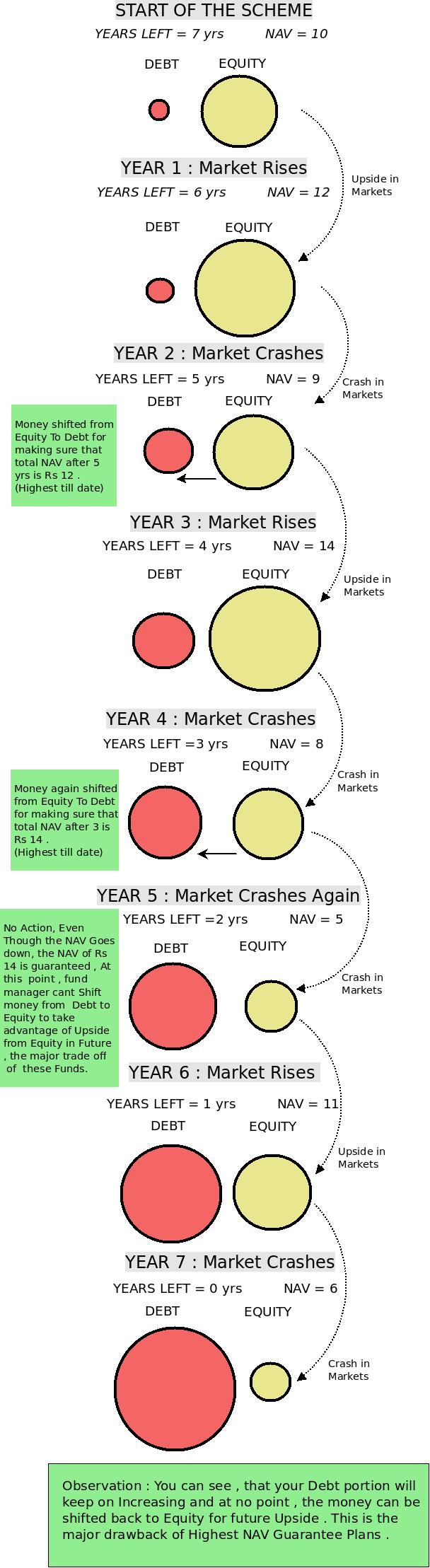
How does a Highest NAV guarantee plan works

How Investors get Confused

You have to read in between the lines; Investors need to understand that these schemes guarantee the “Highest NAV”, READ AGAIN! , it’s Highest NAV and not “Highest Returns” . Normal Investors don’t give much thought before buying these products and normally assume that the returns will be linked to the Equity Markets .

Do you Know , you can Now Subscribe to All the Comments on JagoInvestor !! (You can Unsubscribe Later)

Returns from Highest NAV Guarantee Plans

So, what are the return expectations of these funds? We know, that long-term equity returns, are normally in the 12-15% range while, debt returns turn out to be 6-7%. So, considering the fact, that these products will shift most of their money to debt, by the end of the tenure , we can expect the returns to be in range of 9-10%. We do get some equity upside in these products, but that will be limited. After a point, this product will turn into a debt oriented fund with a major portion in debt . Also if you factor in costs, like premium allocation charges , fund management charges and other yearly charges, the returns will not be what you actually expect.

You will be amazed to know, that the returns expected from these schemes, may be lower than the returns offered by equity-oriented Ulips. The reason being, that the basic objective of protecting the previous high NAV of the fund, may constrain the fund manager’s ability to take risks while allocating funds. So if the market has fallen down, the fund manager can’t take the risk of shifting the money from Debt to Equity to gain from the potential upsides in future , because they have to provide the “Guarantee.”

Read : Important Questions you should Ask an ULIP Agent ?
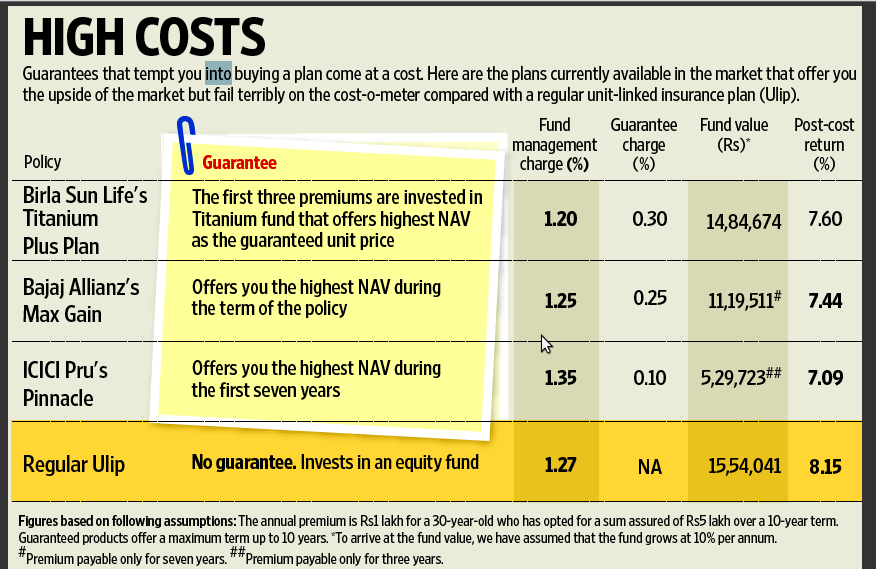
Source : LiveMint Research

Current Products in Market with Highest NAV Guarantee

  • ICICI’s Pinnacle
  • Birla Sun Life Platinum Plus-III
  • Bajaj Allianz Max Gain
  • SBI Life Smart Ulip
  • Tata AIG Apex Invest Assure
  • LIC Wealth Plus
  • Reliance Highest NAV Guarantee Plan.
  • AEGON Religare Wealth Protect Plan

Controlling your emotions with these products

Let’s talk about mistakes from the investors point of view. We, as investors, don’t think with inquisitive, susceptive minds. Getting good returns from stock markets is anyways a tough thing in itself. So when these companies come up with plans like these, which say “highest NAV in 7 yrs”, we have to ask, “How is this possible?” . Dont say it’s not possible at all, just ask how? How do they achieve it? Stop seeing dreams of getting high returns without looking at the risk involved, and try to find out – what is the strategy they’re using , Is there something in between the lines ?

We all want to get great returns, but we have to shed this belief that, companies come up with plans specially for us. All the companies out there exist to earn money, and their motive behind every product is to make money, & generate profits for their companies, so that they keep their shareholders happy. So next time a product like this comes up , you have to control your emotions before getting in and first investigate. The worst part of this whole business, (of guaranteed highest NAV products) is the timing and how it gives naive investors, high illusions about the product. Products like these, take major advantage of psychology of the ordinary saver. Many Investors in smaller towns have broken their Fixed Deposits and taken some loan to invest in products like these, especially SBI Life Smart Ulip and LIC Wealth Plus because of the trust factor with LIC and SBI . See How Agents are Misselling LIC Wealth Plus

Why you should be “Pissed off” At these Insurance Companies

  • Do you Know that, The Securities & Exchange Board of India (SEBI) , the stock market and mutual fund regulator, does not allow mutual funds to guarantee returns. Therefore Mutual funds can not provide guaranteed products which are related to stock markets, but IRDA can approve things like these and all these insurance companies come under the ambit of Insurance Regulatory and Development Authority of India (IRDA). So any Insurance Company can come up with a new Plan , link it with market and start providing “Guaranteed products” . You have to understand that “equity markets” and “guarantees” are a very risky idea together , so please stay away.
  • Do you observe when do all these “Innovative” products come up in Market ? The answer is around end of the year, which is a premier Tax Investment time (Jan , Feb , Mar) . Is innovation in Finance space limited to End of the year ? Why dont these products come through out the year? Why ? The answer is simple , if it comes after anytime other than last 4-5 months of the Financial Year (ie Dec , Jan , Feb , Mar) , no body will bother to invest in these, because no body is bothered to “invest” at all . Companies very well understand investors psychology and their helpless ness at the end of the year because they have to provide investment proofs for Tax exemption as soon as possible . This is not just limited to these products , its true for NFO’s , IPO’s in booming markets , More Sales calls at the end of the year, and other new products .
  • The so-called “Guarantee” is a marketing gimmick and is implicitly a result of the way the investment is structured . what it means is that the strategy they use itself is such that it will provide you the highest NAV , even we can create our own Plan and do what they are doing . But they make sure that Investors feel like they have done years of research and came up with these amazing plans .
  • You have to understand that there is nothing “Innovative” in this product , the fact that 7 companies have come up with the same product proves that its not “innovation” because Innovation is unique . Aegon Religare has gone ahead in this stupidity and introduced their Guaranteed Plan which guaranteed 80% of the Highest NAV , Looks like they think that it makes them look different from others .

Who should Invest in These Products ?

If you are looking for modest returns, like 8-10%, you can invest in these policies. The return of these policies may be high in the beginning, if market does well; but when market starts performing badly, the returns can take a hit and then be in a tight range. Your NAV will be protected for sure, but the returns wont be, since over time the CAGR return will go down. Remember, if your NAV is 10 today and you highest NAV is 20, for a 2 year period, the return is a good enough 41%, but by the 4th year it’s just 18.9% and by the end of 7th year it’s a measly 10.4%. So what you really need, is protection of returns, not the NAV which is just a fixed number.

Is someone misusing your Financial Documents ?

Is it a total truth that you are too careful with your documents? Did someone recently asked for your PAN Xerox (extra) copy without any reason and you gave it without thinking much? Do you handover your Driving license or passport copies to some agent without giving it a second thought? If yes, you need to be careful because this can land you in trouble in big way. There has been a lot of cases reported on this blog by your fellow readers which you can learn from. Let me take some of them.

How one relative misused the pan card for taking loan

A lot of people handover their documents to their relatives without thinking much. They feel they are helping the other person, but you never know how the other person can misuse your documents and get you in trouble. Read this case

One of my cousion taken a two wheeler loan in 2005, and i had given my pan card duly self attested at the time of taken loan.
Now i had applied for 2 wheeler loan in 2010, it got rejected upon applied to CIBIL report i came to know that i m the coapplicant of the two wheeler loan taken by my cousion in 2005. But unfortunetly he died in 2010 . So i had made the complete payment including all bouncing charges as well as the principal amount dues on him. But as i am the co-owner as per the bank records my name also reflect as an overdues amount (Defaulter) in your CIBIL Report which is harming my credit Worthiness in the market. I just spoke to the HDFC CUSTOMER CARE DEPT they said your loan is clear and had been reported to CIBIL upon checking again with CIBIL ,now report shows as settled . I had made full payment still its showing settle please help me out what i need to do now Please note that i do not have any direct dealing with the bank in the above said loan i just made a mistake of giving my sign in the reference column for which i have paid a price of making payment of RS 6322 to bank. (source)

How one friend used friends reference to make his co-applicant

Friends are forever, until they take advantage of your trust. A lot of people give their documents to their friends for being a reference (guarantor), but they themselves don’t understand what does guarantor mean? Read this below case to know what happened with one person

One of my friends took a car loan from a nbfc 3 years back and he wanted a reference for this loan (i now realize there is no such thing as a reference for a loan) i obliged and gave him a duplicate copy of my pan card. For atleast 2 years i have been applying for credit cards and getting rejection letters from all the banks. I finally was fed up with this and decided to get my cibil report and was shocked to see that i was the co-applicant for the car loan my friend had taken 3 years back. He had defaulted on this loan which was reflecting on my cibil report and that being the main reason for me not getting any credit card.

Like i mentioned earlier i had given my friend a copy of my pan card but i had never signed any loan application form, so i followed up with my friend (who still claims that i was supposed to a reference for this loan) and also with the customer care at the NBFC (who i must say were extremely rude). I managed to get the loan application form from the NBFC and i’m a cent percent sure that my signature has been forged on the form. Now my friend (would not want to call him a friend anymore) claims that the person who gave him this loan never told him about me being a co-applicant and he always thought i was only a reference. (source)

How an agent used documents of someone to to take advisor license

We call a lot of agents to home to buy financial products ,we give them our financial documents without realising that it can be misused if we dont want to go for the product later , we never ask it back . Read the following case based on this.

It has come to my notice that an advisor license was taken in my name in MetLife, Asansol Branch under Sales Manager by the name Mr. Debrup Banerjee. This person had approached me for a Life Insurance policy and had some papers signed by me. The Policy never materialized, but the papers (EPIC, PAN Card, Photo) was used to take out a License in my name. In fact, I was working in Bihar Sharif when the IRDA Exam was taken. A more serious and criminal act on part of Mr. Debrup Banerjee was to open an account with the Axis Bank in my name using the same papers. SMS alerts from MetLife has brought these misdeeds of Mr. Debrup Banerjee to my notice. I would request you to take necessary steps to declare the Advisor License, taken by Mr. Debrup Banerjee for MetLife, null and void. (source)

Make sure you take care about whom you are handing over your financial documents to. People can misuse it and take advantage which can get you into trouble later and you will come to know about it only when things are out of control.

PPF interest rate now at 8.6%, investment limit 1 lac

There is good news for all the investors who are primarily debt instruments investors. Govt on Friday increased the PPF interest rates to 8.6% , which was 8% from very long time and the investment limit for PPF is increased to 1 lac from old 70,000 . This will be applicable from the dates which will be notified by govt very soon. There are some other changes which were done in other investment products , which are

Source : Hindustan Times

  • The Maturity tenure for National Saving Certificate (NSC) has been reduced to 5 yrs (earlier it was 6 yrs) and interest rates increased to 8.4% from 8%
  • A new National Savings Certificate (NSC) would be launched with a 10-year maturity with an annual interest rate of 8.7 per cent.
  • Post office savings account interest is increased from 3.5% to 4 per cent.
  • Interest on loans obtained from PPF will be increased to 2% p.a. from existing 1% p.a
  • Kisan Vikas Patra has been discontinued from now onwards . The committee had said that the KVP was a bearer-like certificate with a regulated premature closure facility and was open to abuse by tax dodgers. They can be bought or sold without going to the post offices.
  • Maturity period for Post Office Montly Savings Scheme (POMIS) has been reduced to 5 yrs and interest rate has been increased from 8% to 8.2%. Also the 5% bonus on maturity has been scrapped.
  • Commission for agents on PPF and Senior Citizens Savings Schemes are scrapped. For any other instruments, agents commission will now be 0.5% against 1% earliar . According to the Gopinath Committee, the agents were paid around Rs 2,400 crore commission in 2010-11.
  • The interest rates of varios tenures fixed deposits in Post Office is increased , for example for 1 yrs Fixed deposit , the new interest rates is 7.7% against 6.25% earliar . There are changes in other tenure fixed deposits also (See image above) . This has happened because interest rates on small saving instruments have been aligned with G-sec rates of similar maturity, with a spread of 25 basis points.

These measures are in sync with the recommendations of former RBI deputy governor Shayamala Gopinath committee that submitted its report to finance minister Pranab Mukherjee on June 7 this year.

Jayant Pai has an interesting comment on ppfas blog which goes like this

By now you must be aware that the interest rates on Government Small Savings Schemes (SSS) have been increased. Newspapers are going around town proclaiming that this is a bonanza for small investors. Well, it is true that soon (Most probably from December 1, 2011) you will be earning more by investing in these instruments but in a way this move is similar to the recent deregulation of bank savings account rates by the Reserve Bank of India .

You may be earning more today but this could change in the future. In other words, interest rates on all SSS will be dynamic and linked to the yield for comparable Government Securities although the rate changes will occur only once in a year and the relevant announcement will be made on April 1 each year. The Government will however ensure that a spread ranging from 25 to 50 basis points over the relevant benchmark security will be maintained.

Note that the news of PPF interest hike was published on Jagoinvestor news blog within few minutes of govt decision

Economic Event Calendar

Economic Calendar >> Add to your site

Best Mutual Funds

Recent Posts

Search This Blog

IPO's Calendar

Market Screener

Industry Research Reports

NSE BSE Tiker

Custom Pivot Calculator

Popular Posts

Market & MF Screener

Company Research Reports